

From Your First Payslip to Age 55: How Your Home Shapes Your CPF
Your CPF savings start with your first job, and a home gives them more than one job to do. Here’s how housing, MediSave and retirement savings fit together before you turn 55.
Remember your first proper payslip?
You were probably looking forward to earning your own money, then noticed the amount reaching your bank account was smaller than your salary. Some of it had gone into CPF. Retirement wasn’t something you were thinking about yet.
Then life moved along. A first flat, a monthly mortgage, maybe children. The Ordinary Account that used to be just a number on your CPF statement was now helping to pay for your home.
Your payslip, your flat and your 55th birthday all run through the same CPF accounts.
It begins with a payslip
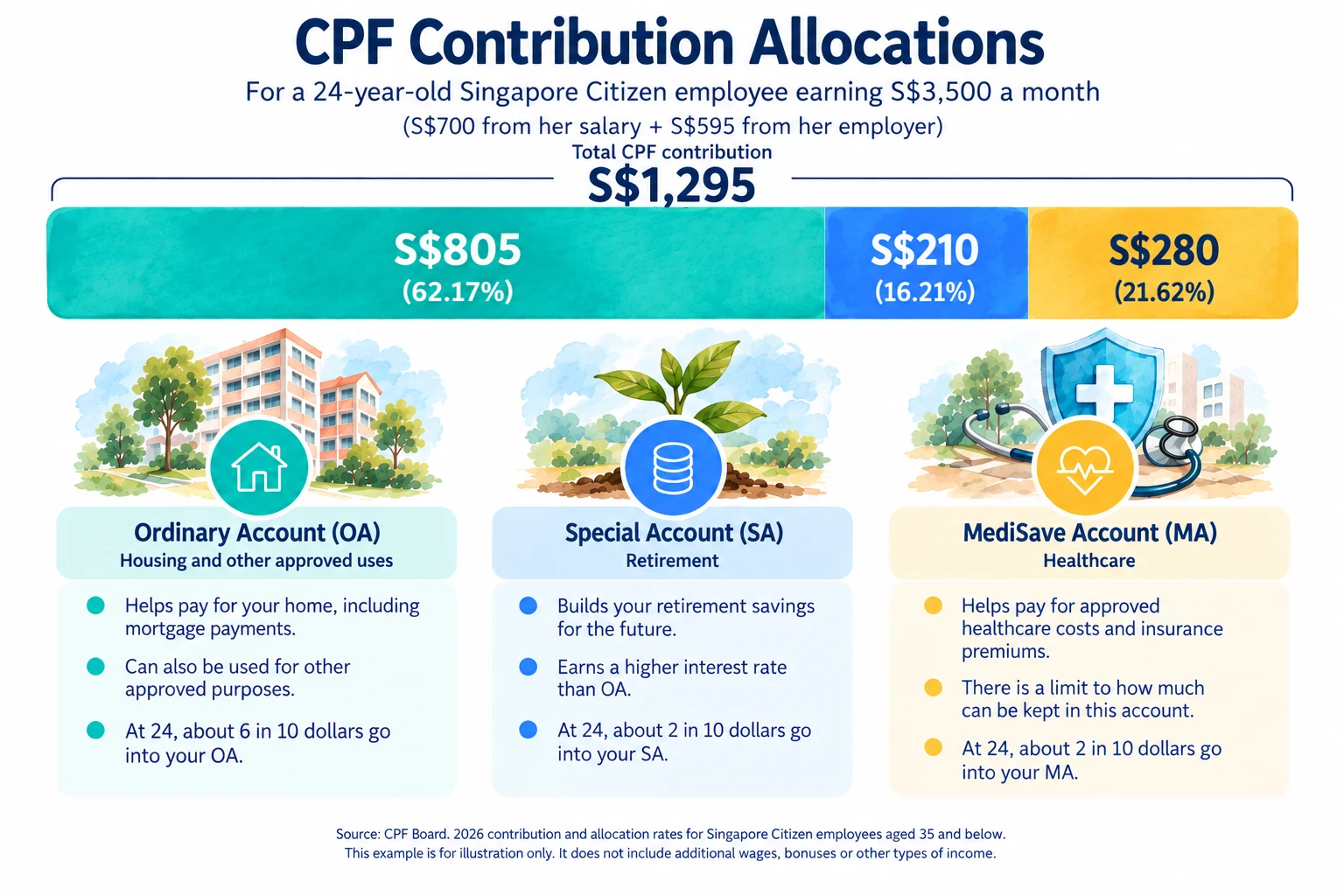
Meet Nadia. She’s 24, just started work, and earns S$3,500 a month.
Under the standard 2026 CPF rates for Singapore Citizen employees of her age, S$700 comes out of her salary and her employer adds S$595. That’s S$1,295 going into her CPF every month.
Want to see how your own pay is divided? Try our CPF Contribution Calculator for an estimate based on your monthly salary.
The split changes as she gets older. At 24, most of it goes to her Ordinary Account (OA), which can help with a future home. Her Special Account (SA) builds retirement savings, while her MediSave Account (MA) supports healthcare needs.
As she moves into older age groups, a smaller share of new contributions goes to OA, while more goes towards retirement and healthcare.
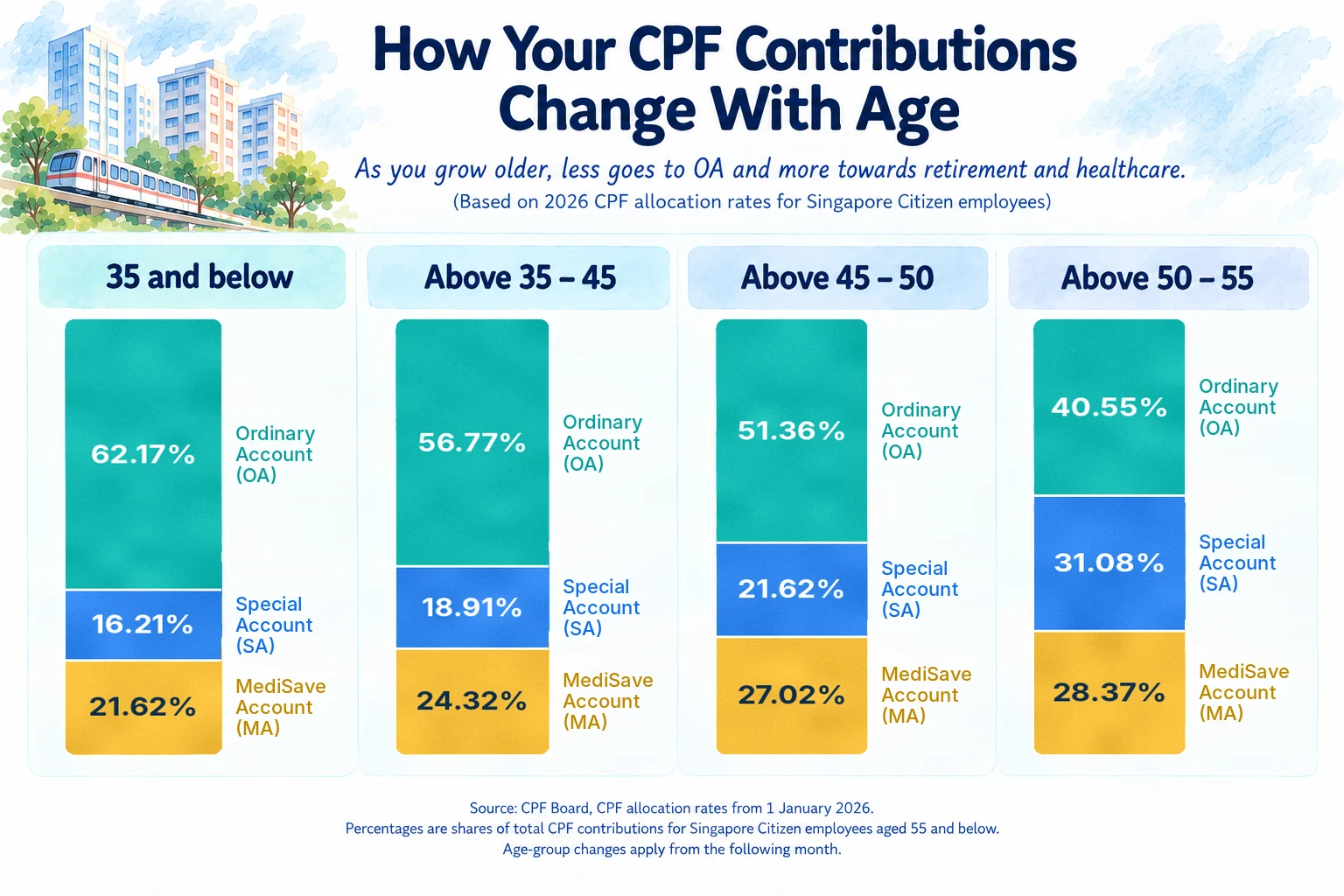
Read the 2026 allocation percentages as text
| Age | OA | SA | MA |
|---|---|---|---|
| 35 and below | 62.17% | 16.21% | 21.62% |
| Above 35–45 | 56.77% | 18.91% | 24.32% |
| Above 45–50 | 51.36% | 21.62% | 27.02% |
| Above 50–55 | 40.55% | 31.08% | 28.37% |
The new split only applies to future contributions. Her existing OA savings don’t move to another account just because she gets older.
Then a home enters the picture
A few years later, Nadia and her husband collect the keys to their first HDB flat. Between renovation, furniture and a new mortgage, cash gets tight.
Using OA savings for the monthly instalment eases that pressure. The trade-off is that money used for the flat no longer earns interest in OA.
Each month, new contributions add to Nadia’s OA, while housing payments draw money out. Interest helps grow the savings that remain. If her mortgage takes up most of what’s coming in, her OA may grow slowly or even shrink.
That doesn’t automatically mean something has gone wrong. Her CPF is helping to pay for her home today.
Paying with OA frees up cash now but leaves less in OA to grow for later. Paying more in cash does the reverse. Which works better depends on how much of a cash buffer the household needs for groceries, childcare or a rough patch at work.
For Nadia, there’s no single right answer. What matters is understanding how today’s mortgage payments affect the savings she’s building for the years ahead.
When MediSave fills up
This is a part of CPF that isn’t always obvious.
MediSave pays for approved healthcare costs and insurance premiums, but there’s a limit to how much can be kept in the account. It’s called the Basic Healthcare Sum (BHS). In 2026, that limit is S$79,000 for members below 65.
So what happens when Nadia reaches it?
Any amount above the MediSave limit is channelled to another CPF account. While she’s below 55, it generally goes:
- To her Special Account (SA) if she hasn’t yet met the current Full Retirement Sum for this purpose.
- To her Ordinary Account (OA) if her SA savings, including any qualifying investments made using SA savings, already meet that sum.
That means reaching the MediSave limit could change how Nadia’s OA and SA grow, even without a change to her salary.
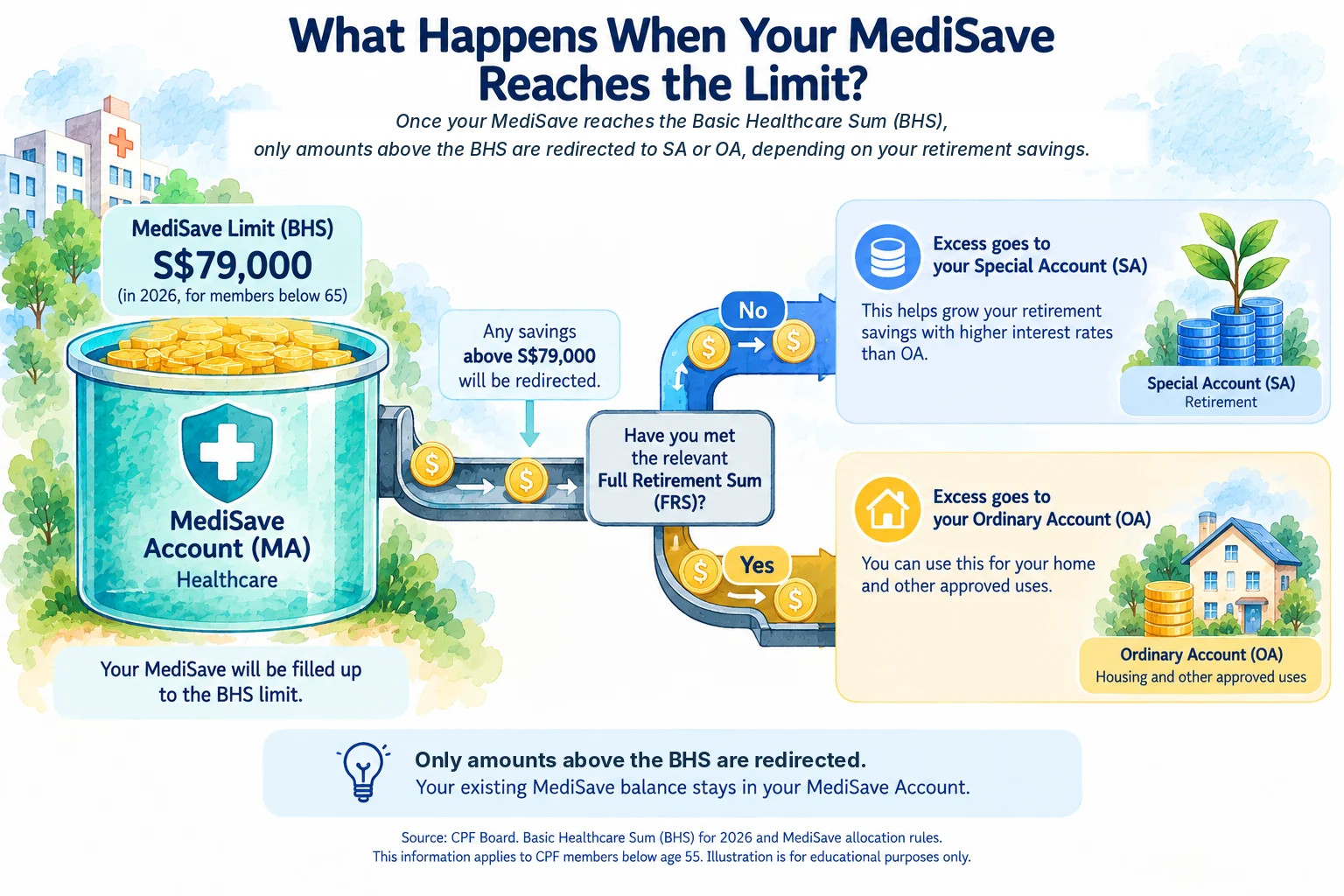
There’s an important distinction here. Reaching the limit doesn’t mean Nadia’s existing MediSave savings suddenly become available for her mortgage. The amount within the limit stays in MediSave for healthcare.
And the overflow won’t necessarily continue every month. Medical expenses and approved insurance premiums can reduce her balance, while the Basic Healthcare Sum is adjusted annually for members below 65.
It’s another reason why her CPF accounts may grow differently as the years pass.
As 55 approaches
As Nadia gets closer to 55, she may wonder what her OA and SA savings mean for retirement.
Under current rules, CPF creates a Retirement Account at 55, using SA savings first and OA savings if needed, up to the applicable Full Retirement Sum. Her SA then closes, with any remaining SA savings moving to OA. Our planner stops before these changes happen.
For people turning 55 in 2026, the Basic Retirement Sum (BRS) is S$110,200 and the Full Retirement Sum (FRS) is S$220,400. The BRS is a benchmark for basic retirement needs, excluding rent, while the FRS is twice the BRS. The Enhanced Retirement Sum (ERS) is S$440,800 in 2026 — the prevailing Retirement Account top-up limit for members aged 55 and above.
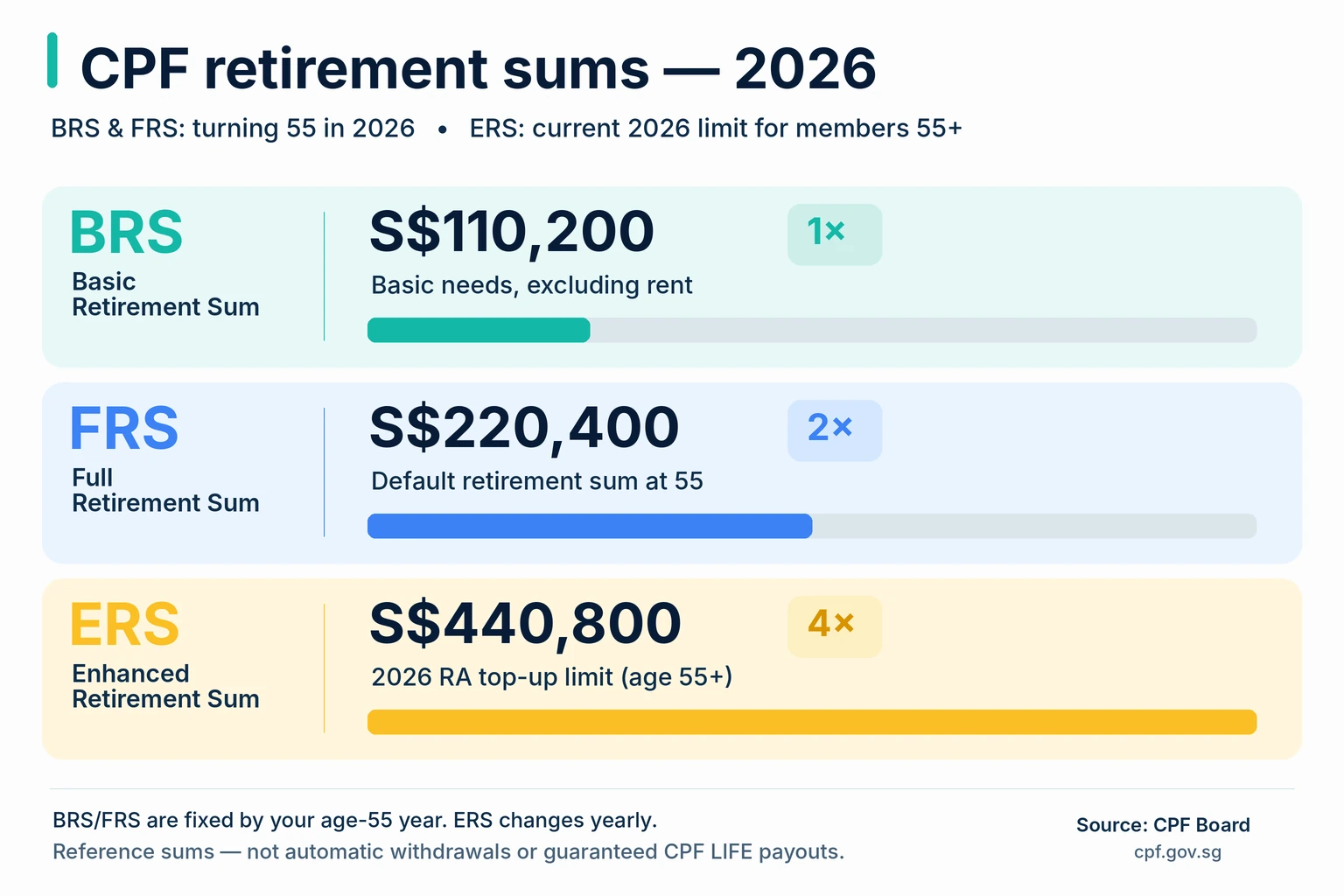
Nadia’s BRS and FRS will depend on the year she actually turns 55 and will then remain fixed for her cohort. ERS works differently: it is the prevailing top-up limit and changes over time. For someone still many years away, future retirement sums used in a projection are estimates, not officially announced figures.
These benchmarks are useful points of comparison, not a promise of how much she can withdraw or receive in retirement.
See your own numbers
You don’t need to have retirement figured out to start. You can begin with where your contributions go, how much of your OA your mortgage uses, and whether MediSave is approaching its limit.
The CPF Savings to 55 Planner helps Singapore Citizen employees within its supported scope estimate how their OA, SA and MA balances could look up to the end of the month before they turn 55. It considers eligible salary contributions, housing deductions, CPF interest and MediSave limit rules.
When you see your results, try looking at three things:
- Your OA after housing payments. Is it growing, staying roughly the same or shrinking as the mortgage continues?
- Your MediSave and SA. Is MediSave approaching its limit? Could any overflow change where future CPF savings go?
- Your OA and SA together. How do they compare with the retirement sums shown? Leave MediSave out of that comparison, since it’s meant for healthcare.
The planner is an illustration based on what you enter and the assumptions it uses. It can’t know future changes in your income, CPF policies, medical expenses or housing plans. It also doesn’t work out your actual Retirement Account, withdrawal eligibility, CPF LIFE payouts or property-specific housing limits.
You might discover that your OA is growing more slowly than expected while your SA continues building. Or that reaching the MediSave limit could change where some of your savings go.
Neither result tells you exactly what to do. But both can help you see what deserves a closer look.
Your first payslip, your first home and the years approaching 55 are all part of the same journey. Understanding how they connect gives you a clearer picture while there’s still time to plan.
Explore the CPF Savings to 55 Planner →
Nadia and her household are fictional. The contribution example uses standard 2026 CPF rates for an eligible Singapore Citizen employee earning ordinary wages. The 2026 retirement sums are published CPF figures; future projections are illustrative. The Pocket Umbrella is an independent educational website and is not affiliated with CPF Board. This article provides general education, not personalised CPF, housing or retirement advice.
Official references
- CPF Board — CPF contribution rates
- CPF Board — CPF allocation rates from January 2026
- CPF Board — How CPF contributions are allocated
- CPF Board — Basic Healthcare Sum
- CPF Board — What happens to MediSave savings above the BHS?
- CPF Board — CPF retirement sums
- CPF Board — What happens to CPF savings at 55?