

If Your CPF OA Inflow Drops, What Happens to Your Mortgage?
Jia has been talking about taking a year away from work.
Nothing dramatic. She just wants some breathing room — time to step away, think about what comes next, and not rush straight into another job.
When she and Marcus finally sit down to talk about it properly, one of the first questions is predictable:
“What happens to the mortgage?”
Their HDB loan is S$1,500 a month. For the past few years, they have paid it entirely from CPF: S$750 from Marcus’s OA and S$750 from Jia’s.
Marcus and Jia are fictional characters used to illustrate a simplified household scenario.
If Jia stops working, her new CPF contributions stop too.
It sounds as though the household would suddenly need another S$750 in cash every month.
But that is not necessarily what happens.
Jia already has money sitting in her OA. In this example, enough to keep paying her half of the mortgage for 27 full payments — a little over two years.
So Marcus and Jia have a choice:
use Jia’s OA and keep more cash available now, or preserve her OA and start paying her S$750 share in cash.
Neither is automatically better. They simply use a different buffer.
How did Jia build up that buffer?
Assume Marcus and Jia are both 35 or younger and each earns about S$4,500 a month. At current CPF rates, roughly S$1,035 goes into each person’s OA every month.
Their mortgage is split evenly:
S$750 from Marcus’s OA + S$750 from Jia’s OA
When they bought the flat, assume they each had S$10,000 left in OA.
They then worked for another three years.
Each month, roughly S$1,035 came in and S$750 went towards the mortgage, leaving about S$285 behind.
Over 36 months:
S$285 × 36 = S$10,260
So for this illustration, each of them has about S$20,260 in OA when Jia begins her career break.
We are keeping this deliberately simple — no salary increases, bonuses or interest during those first three years.
The point is to understand the household decision, not recreate their CPF statements down to the cent.
Option 1: Keep using Jia’s OA
The simplest thing Marcus and Jia can do is leave the mortgage arrangement as it is.
Marcus keeps paying S$750 from OA.
Jia keeps paying S$750 from hers.
The difference is that Jia no longer has new contributions flowing in.
Her existing OA becomes the buffer.
The quick maths is:
S$20,260 ÷ S$750 ≈ 27 payments
CPF Housing Runway reaches the same useful conclusion: Jia can cover 27 full S$750 payments before her share first runs short.
The calculator will not match simple division exactly down to the final dollar because payment timing and OA interest matter too, but the planning takeaway is clear.
Swipe sideways to view the full chart
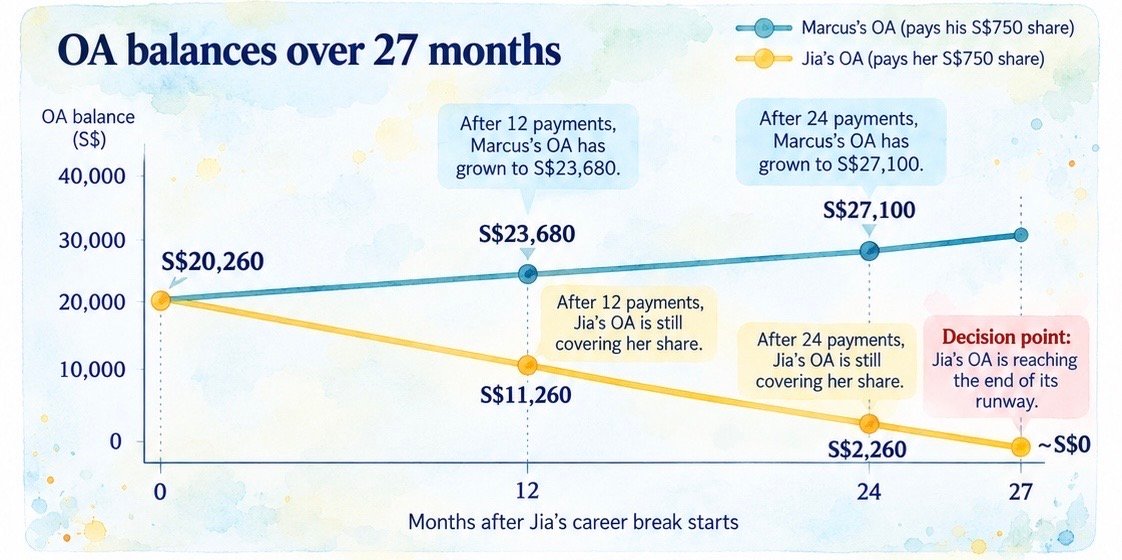
Marcus’s OA is still rising here because he continues paying only his S$750 share while about S$1,035 still enters his OA each month. If he later takes on more of the mortgage, that becomes a new decision and a new calculation.
A one-year break fits comfortably inside that runway.
So does a two-year break.
During either period, Marcus and Jia need no extra cash for the mortgage if Jia keeps using her OA.
Meanwhile, Marcus is still working. Around S$1,035 continues to enter his OA each month while only S$750 goes towards the mortgage, so his own balance keeps growing by roughly S$285 a month before interest.
While Jia’s buffer is shrinking, Marcus’s is quietly getting larger.
Option 2: Preserve Jia’s OA and use cash instead
Marcus and Jia could make the opposite choice.
Marcus keeps paying his S$750 from OA.
But instead of using Jia’s OA, the household replaces her half with cash:
S$750 from Marcus’s OA + S$750 cash
Jia’s OA stays largely untouched.
The trade-off is immediate.
| Use Jia’s OA | Preserve Jia’s OA | |
|---|---|---|
| Extra mortgage cash each month | S$0 | S$750 |
| Extra cash over 1 year | S$0 | S$9,000 |
| Extra cash over 2 years | S$0 | S$18,000 |
| Jia’s OA | Gradually falls | Largely preserved |
| Marcus’s OA | Continues growing | Continues growing |
| What this protects | Cash today | More CPF savings for later |
That is really the decision.
Not simply “CPF or cash?”
A better question is:
“Which buffer do we want to use first?”
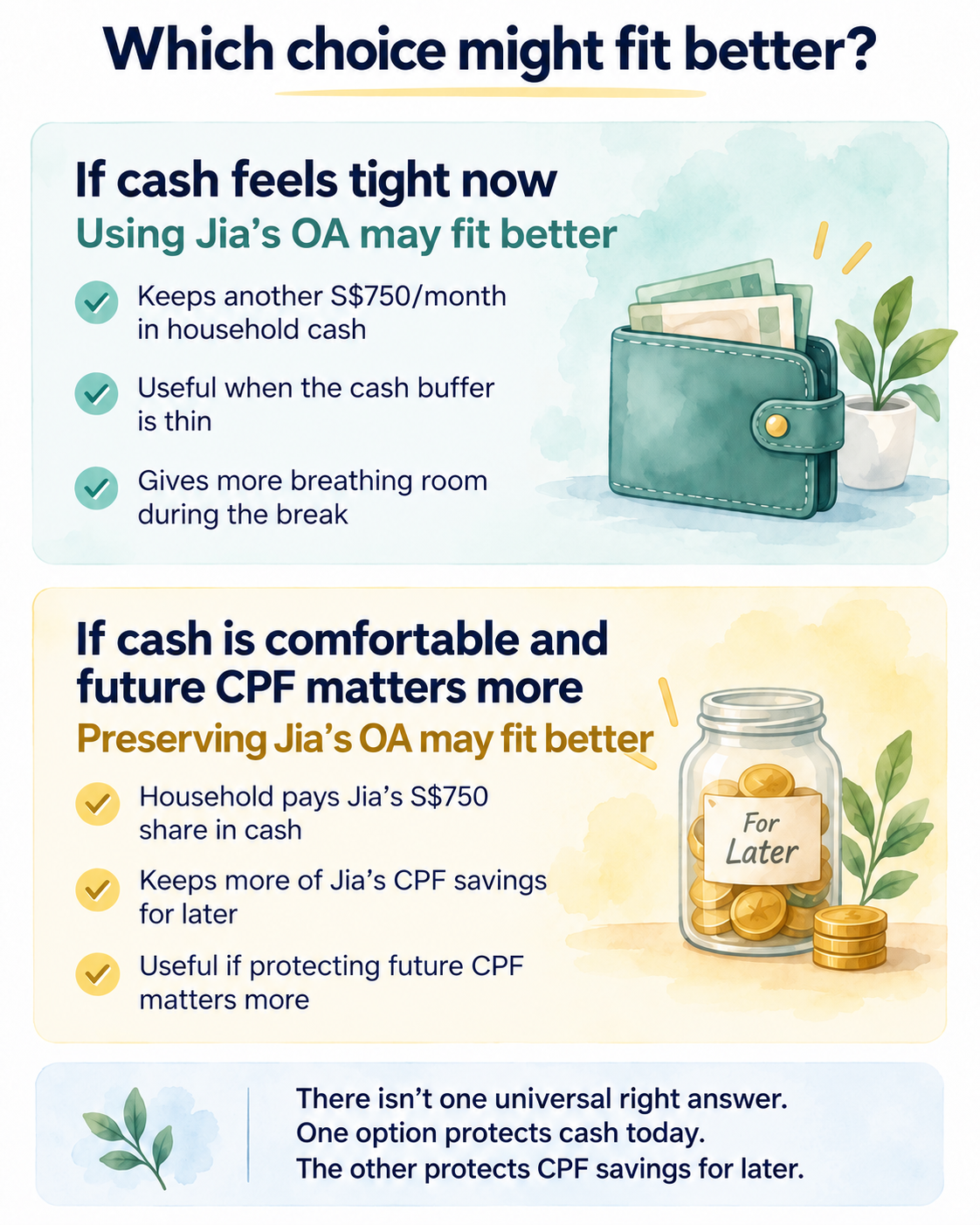
Which option might make more sense?
Imagine Marcus and Jia do not have a huge emergency fund.
Going from two salaries to one already changes the feel of the household budget. Groceries, insurance, school costs, transport and the occasional unpleasant surprise still need to be paid.
In that situation, keeping another S$750 in the bank every month could matter a lot.
Using Jia’s OA gives them breathing room.
Over a year, that is S$9,000 they do not have to find from household cash. Over two years, it is S$18,000.
But another household may be in a very different position.
If Marcus and Jia already have a comfortable cash reserve, they may prefer to leave Jia’s OA alone.
That keeps more of her CPF savings intact for later, and her balance continues earning CPF interest while it stays in the account.
For a household planning to keep the flat for many years, that can matter as Jia gets closer to 55 and starts looking at how much CPF she has available for retirement.
If they eventually sell the flat, CPF used for the property, together with accrued interest, generally has to be refunded back into the owner’s CPF account from the sale proceeds.
So the trade-off is less about one option being “better” and more about what they want to preserve:
more cash today, or more CPF savings for later.
For the bigger question of whether the household can afford to live on one income overall, our earlier article, Can a Single Income Really Survive in Singapore?, looks at the wider household budget.
Here, we are isolating just the mortgage.
What happens when Jia’s OA eventually gets low?
Marcus and Jia do not need to decide the rest of their mortgage today.
If Jia’s break lasts long enough for her OA to approach the end of its runway, they can reassess before that point.
Marcus may have built up more OA by then because he has continued working while paying only his S$750 share.
They could decide that Marcus pays more from his OA, introduce some cash, or use a mixture of both.
The important thing is to decide before Jia’s OA can no longer cover her share.
And if they want to change how much each person pays from CPF, they should check the current CPF, HDB or lender process rather than assuming the payment arrangement will change by itself.
Try both versions instead of guessing
This is where CPF Housing Runway can help.
Start with the arrangement Marcus and Jia already have:
S$750 from Marcus’s OA + S$750 from Jia’s OA
To follow Marcus and Jia’s example, use the “Keep today’s split” result — that is the view that keeps their existing S$750 + S$750 CPF arrangement.
See how long Jia’s existing OA could continue paying her share if her new contributions stop.
Then try:
S$750 from Marcus’s OA + S$750 cash
with nothing coming from Jia’s OA.
Compare the two over the period you are actually planning for — six months, one year, two years.
The runway does not tell you which choice is better.
It shows you what each choice uses up.
A few things worth remembering
CPF accounts are individual. Marcus’s growing OA does not automatically refill Jia’s when hers gets low.
Simple division is only a guide. CPF contributions, mortgage deductions and OA interest do not all happen at the same moment.
CPF housing rules still apply. The balance shown in OA is not automatically usable for every property in every situation.
Changing the payment setup takes action. Check the current CPF, HDB or lender process if you want to adjust how much is paid from CPF.
Jia’s career break also affects more than housing. If she has no CPF-contributing income, new contributions to her other CPF accounts stop too. We are focusing on OA here because that is the part connected directly to the mortgage.
The short version
Jia stopping work does not necessarily mean Marcus and Jia suddenly need another S$750 in cash every month.
Her existing OA gives them time.
In this illustration, it can cover 27 full payments of her S$750 mortgage share — a little over two years.
That leaves them with a choice:
Use Jia’s OA: keep more household cash available now while her OA gradually falls.
Preserve Jia’s OA: pay S$750 in cash each month — S$9,000 over one year or S$18,000 over two years — while keeping more of her CPF savings intact for later.
There is no single answer that fits every household.
The useful question is:
Which buffer would you rather use first — your cash, or your CPF OA?
This article is a planning illustration, not personal financial advice. Check your own CPF and housing-loan details before making financial decisions.