

Your Monthly Budget Might Be Right — and Still Miss Part of the Picture
About 5 min read
In this article
- A normal month is only one view of your household
- Some costs disappear between the months
- Dividing everything by 12 is useful, but not always enough
- The aim is a more representative number
- It still will not predict every month
- Try looking at the year before changing the budget
- A wider lens on your household
You probably have a number in your head. Maybe it is S$4,000 a month, maybe S$5,000, maybe more.
It is the number you would give if someone asked roughly how much your household spends each month, and it may be a perfectly reasonable estimate. You know what housing costs. You know roughly what groceries come to. Utilities, transport, meals, subscriptions and school expenses are familiar enough that, after a while, you develop a fairly good feel for what an ordinary month looks like.
Then a less ordinary month arrives.
The annual insurance premium is due. The car needs servicing. A school expense crops up. Two subscriptions renew within weeks of each other, and somewhere in the calendar is the family holiday you already knew you were taking.
None of this is especially surprising, but when several of these costs arrive close together, the month can still feel unexpectedly expensive.
Suppose your household normally comes in at around S$5,000 a month. Most months, that figure feels about right. Then one month includes insurance, servicing and a birthday, and suddenly the number is much higher.
It is tempting to write that month off as unlucky. Another possibility is that S$5,000 is a good description of an ordinary month, but not yet a complete planning number for the year.
A normal month is only one view of your household
Household life does not happen in twelve identical copies of the same month.
Some costs appear every week and others every month. Some turn up once or twice a year. A few are not bills at all, but things you already know are likely to happen: festive spending, birthdays, new school items or a planned holiday.
Seen month by month, those costs can look like interruptions. Seen across a full year, they are simply part of running the household.
That changes the question slightly. Instead of asking only, “What do we normally spend in a month?”, it can be useful to also ask, “What does the next year of this household realistically require?”
The two questions are related, but they are not quite measuring the same thing.
A normal month and a realistic planning number aren’t quite the same thing.
Your household may have a monthly figure that feels accurate for everyday life and still miss costs that do not show up neatly every month. Looking across the year helps turn a familiar monthly estimate into a fuller planning number.
Some costs disappear between the months
Monthly budgeting is convenient because so much of life is organised that way. Salaries arrive monthly. Mortgages are paid monthly. Utility bills and credit-card statements turn up on roughly the same rhythm.
Other household costs are easier to lose sight of.
A S$1,200 insurance premium does not feel like a monthly expense when it is paid once a year. A S$600 vehicle service is not sitting beside groceries and electricity every month. The same goes for road tax, school-year expenses, festive spending, annual subscriptions and planned travel.
A year might include:
- S$1,200 in annual insurance
- S$600 in vehicle servicing
- S$500 of school-related expenses
- S$360 in annual subscriptions
- S$1,200 set aside for festive spending and gifts
Those costs are not unusual simply because they do not happen monthly.
This is one reason a household can be fairly disciplined with money and still feel as if there is always “something” arriving. Often there is — just not something unexpected.
Dividing everything by 12 is useful, but not always enough
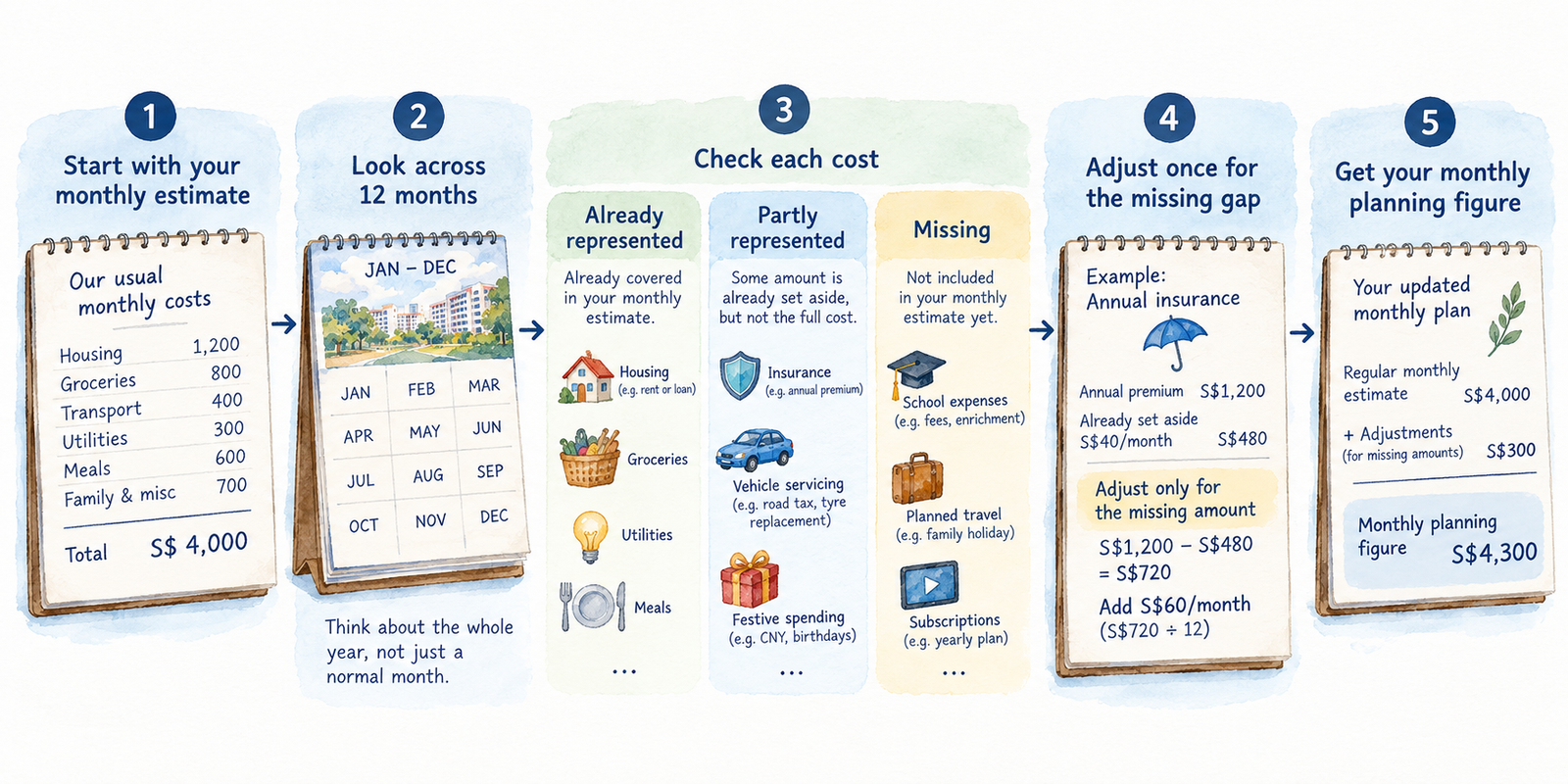
The obvious fix is to list all the annual and irregular expenses, divide them by 12 and add the result to the monthly budget.
Sometimes that works perfectly well. If a S$1,200 insurance premium is coming, thinking of it as roughly S$100 a month is much more useful than ignoring it until renewal day.
The complication is the number you started with.
If your S$5,000 estimate already includes an allowance for some irregular costs, those costs may be partly represented. You might already count about S$40 a month for that insurance premium. Some regular vehicle costs may already be inside your transport spending. School expenses may already be partly reflected in your usual household estimate.
Adding the full future cost on top would then count some of the same spending twice.
For the insurance example, the S$100 monthly equivalent is not completely missing. The S$40 is already inside the S$5,000 estimate, so the useful adjustment is about S$60 a month rather than the full S$100 again.
That small distinction is what makes the exercise more than simply “annual expenses divided by 12.”
The aim is a more representative number
A better starting point is the monthly figure you already recognise, followed by a look at what is coming over the next 12 months.
Some future costs will already be well represented in that number. Others may be partly represented, while some genuinely are missing. Costs can also change: a premium rises, childcare ends, school expenses shift or a temporary commitment disappears.
The job is to adjust for those differences without counting the same underlying expense twice.
For a household that normally thinks in terms of S$5,000 a month, the eventual planning figure might be S$5,100. It could be S$5,300. It could stay close to S$5,000 because most of the irregular costs were already captured.
There is no prize for getting the bigger number. The useful number is the one that better reflects the household you are actually planning for.
It still will not predict every month
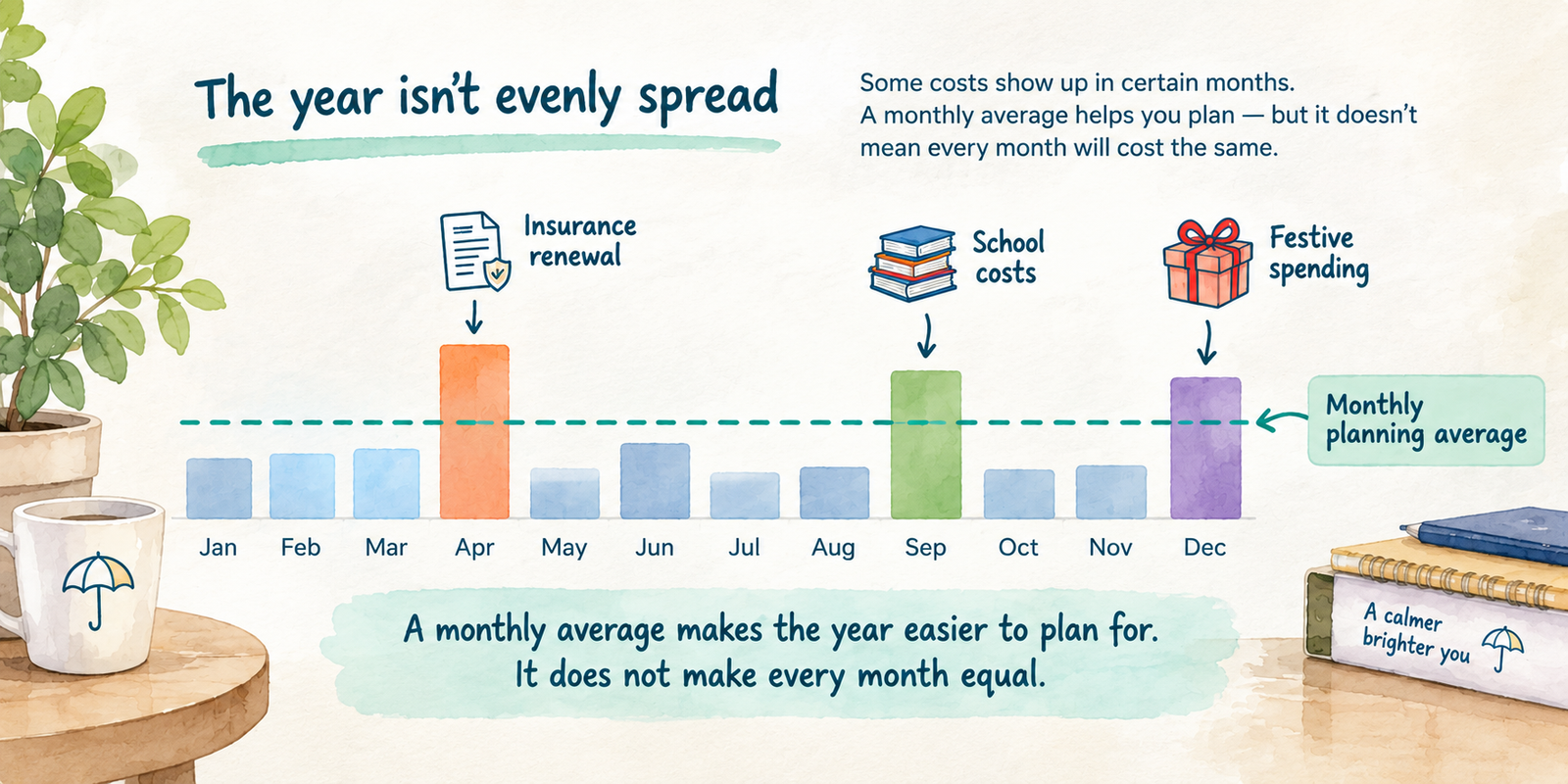
Even a better monthly planning figure does not mean every month will cost the same. The S$100 monthly equivalent for an annual insurance premium helps with planning, but it does not mean the S$1,200 has already been set aside when the bill arrives.
Household spending is uneven. One month carries an insurance renewal, another has the holiday, and another is quiet until the washing machine begins making a noise that probably deserves attention.
The point is not to flatten real life into twelve identical months. It is to take an uneven year and turn it into a figure that is easier to use when making decisions.
That might mean stress-testing the household against one income, deciding how much income is genuinely spare, or working out whether an emergency fund is sized against a realistic month rather than a particularly cheap one.
Your usual monthly number is still useful. Looking across the year simply gives it more context before you ask bigger questions of it.
Try looking at the year before changing the budget
You can do this with a spreadsheet, a notes app or a piece of paper.
Start with the monthly spending figure that already feels realistic. Then look through the coming year for costs that do not appear neatly every month: insurance, vehicle costs, school expenses, subscriptions, festive spending, birthdays, planned trips and anything else you already know is likely to happen.
For each one, work out whether it is already represented in your monthly number, partly represented or missing altogether.
That distinction matters more than simply finding more things to add.
You may discover that your monthly estimate barely needs changing. Or you may finally see why a figure that always seemed sensible somehow left certain months feeling tighter than expected.
Either result is useful.
A wider lens on your household
That is the thinking behind Budget Lens.
It starts with the monthly spending figure you already recognise, then helps you work through the known costs and changes coming over the next year. The aim is to separate what is already represented from what needs adjusting, so the same underlying cost is not counted twice.
You can work through the same idea yourself with a spreadsheet or piece of paper.
Budget Lens is there if you would rather have something guide you through it.
Use Budget Lens to see what changes when you look beyond the normal month.
See your household through a wider lens
Start with the monthly spending figure you already recognise and see what changes when the next 12 months are taken into account.