
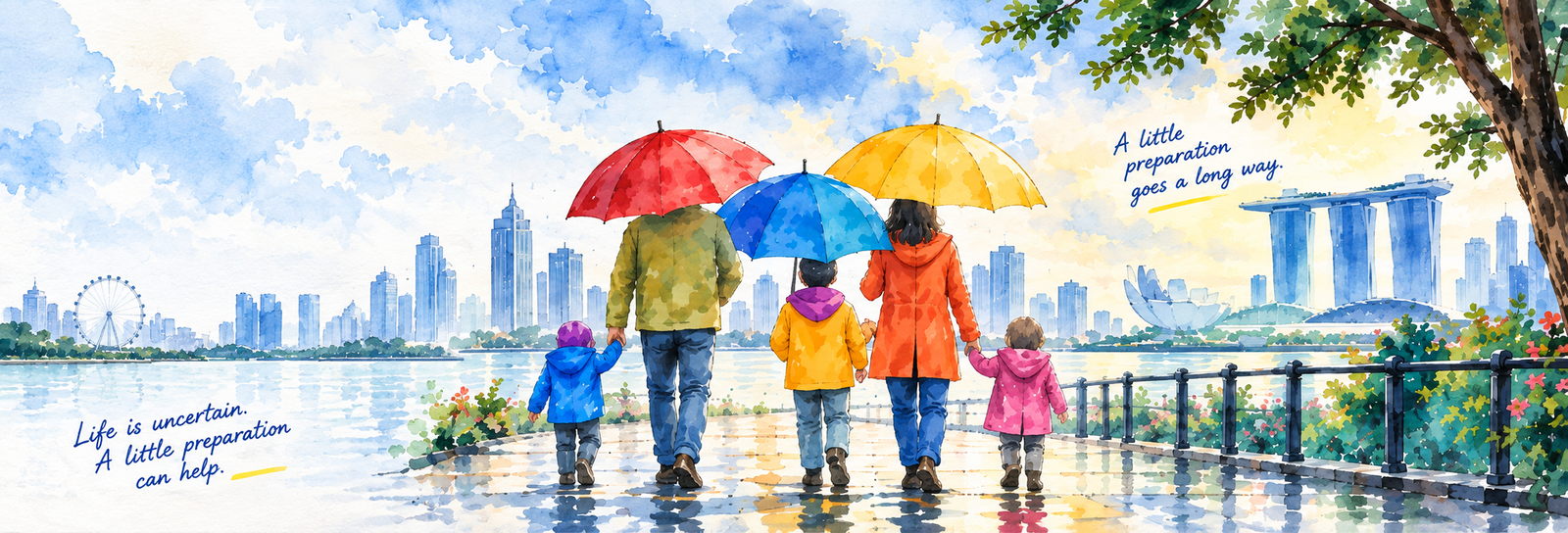
Can a Single Income Really Survive in Singapore?
There is something comforting about having two incomes.
Two salaries. Two CPF contributions. Two people sharing the financial load.
But what happens when there is only one?
Can a single income really support a family in Singapore?
Not just survive from month to month, but still leave enough room for savings, unexpected expenses, the future and, perhaps most importantly, some peace of mind?
As a sole breadwinner, this is something I think about quite often.
Not because I think there is anything wrong with being a single-income household. It is simply a different financial reality.
When there is only one income, there is less room for things to go wrong.
A job loss doesn’t just affect one person’s spending money. It affects the household.
The mortgage still needs to be paid. The grocery bill doesn’t disappear. Neither do utilities, transport, insurance or the expenses that come with raising a family.
And that made me realise something:
Surviving on one income and being financially resilient on one income are two very different things.
Surviving isn’t quite the same as being resilient
A household can be doing perfectly fine on one income. The salary comes in. The mortgage gets paid. There is food on the table. Bills are covered.
Perhaps there is even some money left for savings and investments each month.
On paper, everything works.
But financial resilience asks a slightly different question:
What happens when something doesn’t go according to plan?
Maybe income falls for a few months. Maybe there is an unexpected expense. Maybe the household simply goes through a particularly expensive period.
Financial resilience, at least the way I think about it, isn’t about having enough money to handle every possible problem.
That’s probably impossible.
It’s about building enough of a margin of safety that one problem doesn’t immediately become a financial crisis.
Surviving and resilience aren’t quite the same thing.
A household can be perfectly comfortable today and still have relatively little room to absorb an unexpected change.
Building a margin of safety
A household’s margin of safety can come from different places.
Manageable expenses can reduce how much the household needs every month. Accessible savings can buy time. Insurance can protect against certain large financial shocks.
CPF can provide another layer of longer-term security. Investments can help build resources for the future.
But perhaps the simplest place to start is understanding the relationship between what comes in and what the household really needs.
When everything is going well, we might not think about that very much.
When income falls, it suddenly matters.
Imagine a household bringing home S$7,000 a month. Of that, S$4,000 comes from one income that could disappear.
The household has S$4,500 of essential monthly expenses and S$15,000 in accessible savings.
Today, those numbers might feel comfortable.
But remove that S$4,000 income and only S$3,000 remains. Essential expenses haven’t changed. So the household now faces a S$1,500 monthly shortfall.
With S$15,000 in accessible savings, that shortfall could theoretically be covered for about 10 months, assuming those numbers stayed the same.
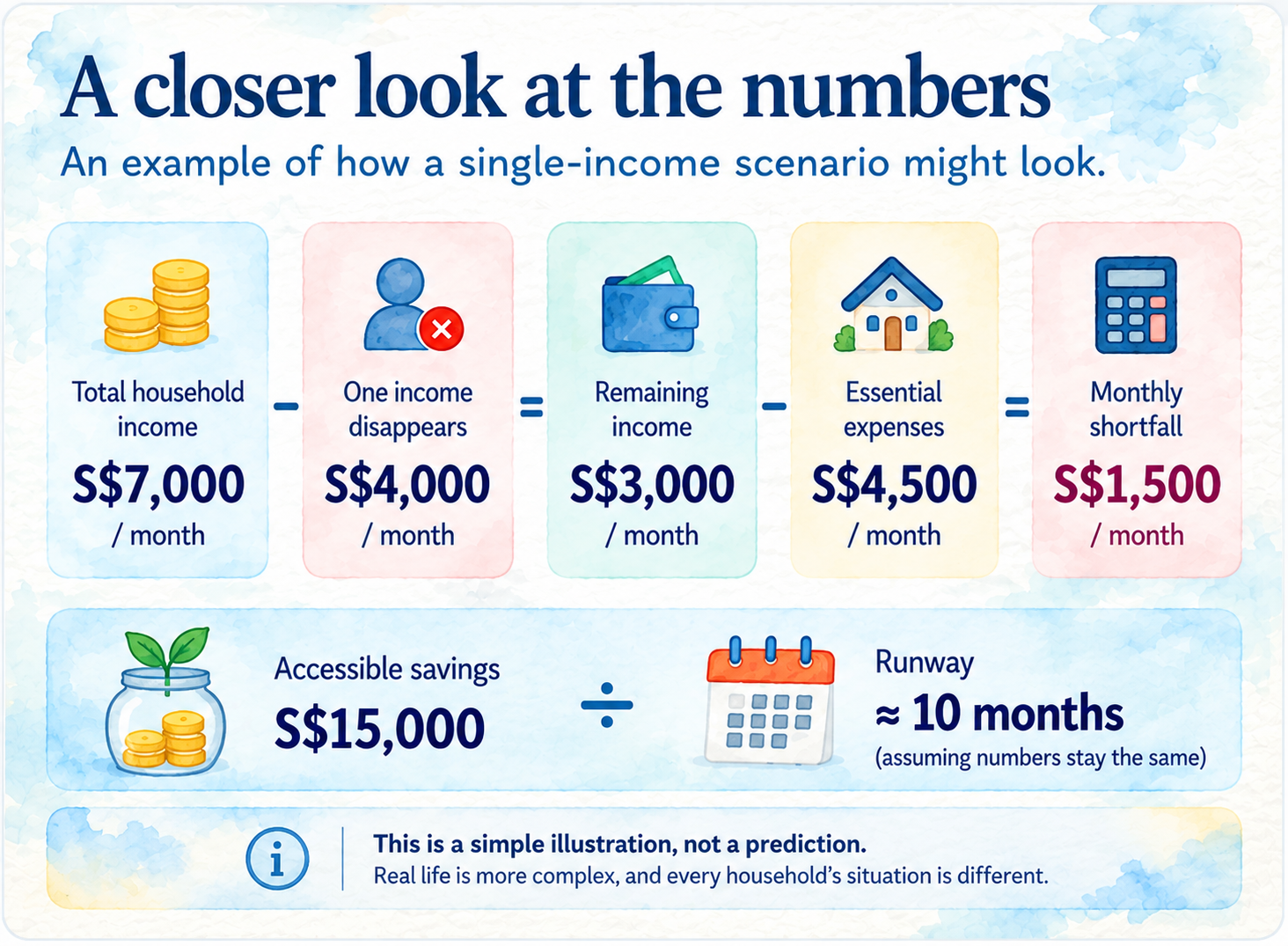
Ten months isn’t a prediction.
Real life doesn’t work that neatly.
Someone might find another job. Expenses might fall. New expenses might appear. Other resources might become available.
The number simply helps make the situation easier to see.
And perhaps that’s the useful part of doing an exercise like this.
It’s about understanding how the different parts of a household’s finances fit together.
The same S$15,000 can provide plenty of breathing room for one household and much less for another.
What would happen with your numbers?
This was one of the questions that eventually led me to build the One-Income Stress Test.
I wanted a simple way to explore the same scenario using different household numbers — not to predict what will happen, but just to make the situation a little easier to understand.
If you’ve ever wondered about your own household, you can try it here.
A margin of safety doesn’t always mean having more
When we think about becoming more financially secure, the obvious answers often involve accumulating more.
Save more. Invest more. Earn more.
Pay off the mortgage faster. Build more passive income. Accumulate more CPF.
There is always another financial target — And almost always a number that could be bigger.
But I don’t think building a margin of safety means endlessly accumulating money because something might go wrong one day.
There has to be a balance.
If the pursuit of financial security takes away all our peace of mind today, it is worth asking what kind of security we’re actually building.
That’s one reason I find the idea of financial resilience more useful than simply chasing financial freedom.
Financial freedom can sound like reaching a destination. Resilience feels different.
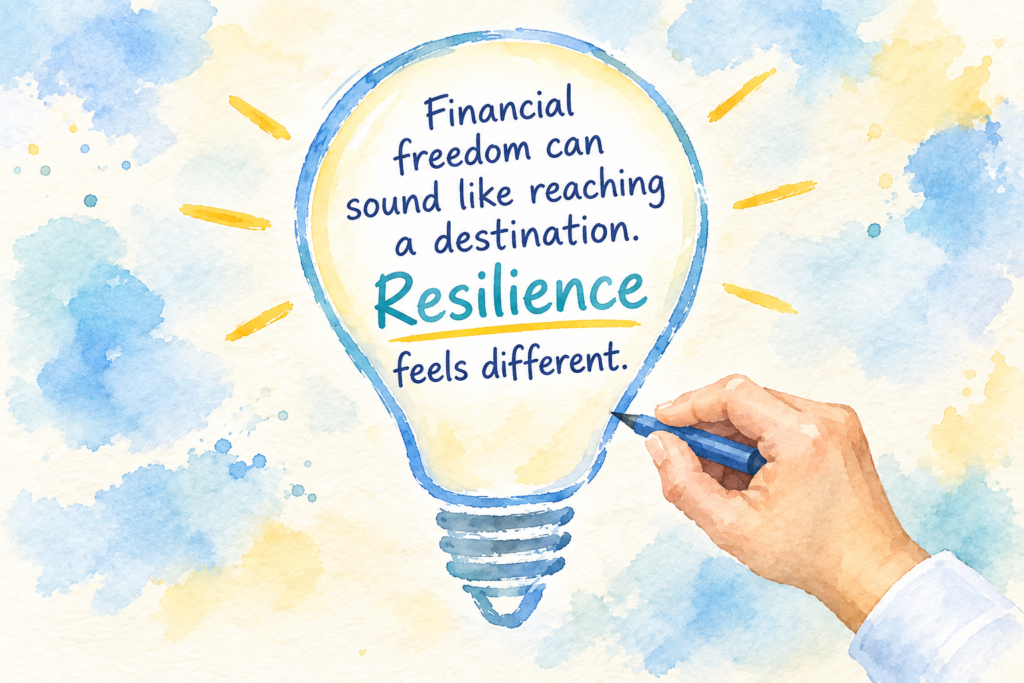
It is about creating enough room in our finances to absorb some of life’s uncertainty without everything immediately falling apart.
And we don’t necessarily need to be wealthy to start building that.
Sometimes resilience is having a few months of accessible savings. Sometimes it is keeping fixed expenses manageable.
Sometimes it is resisting the temptation to turn every salary increase into a lifestyle increase. Sometimes it is having appropriate protection against risks we couldn’t comfortably absorb ourselves.
And sometimes it begins with something much simpler:
understanding our numbers before we need them.
So, can a single income really survive in Singapore?
I think it can.
But perhaps survival is the wrong goal.
The more useful question might be:
Can a single-income household build enough of a margin of safety to absorb the days when life doesn’t go according to plan?
I’m still figuring that out too.
There probably isn’t one perfect number that suddenly makes a household financially resilient.
Life is too complicated for that.
But we can understand our situation a little better. We can build a little more breathing room where we can.
And we can prepare for some of the things we hope never happen.
We don’t have to predict every financial rainy day before it arrives.
Sometimes it helps simply to carry a small umbrella.